
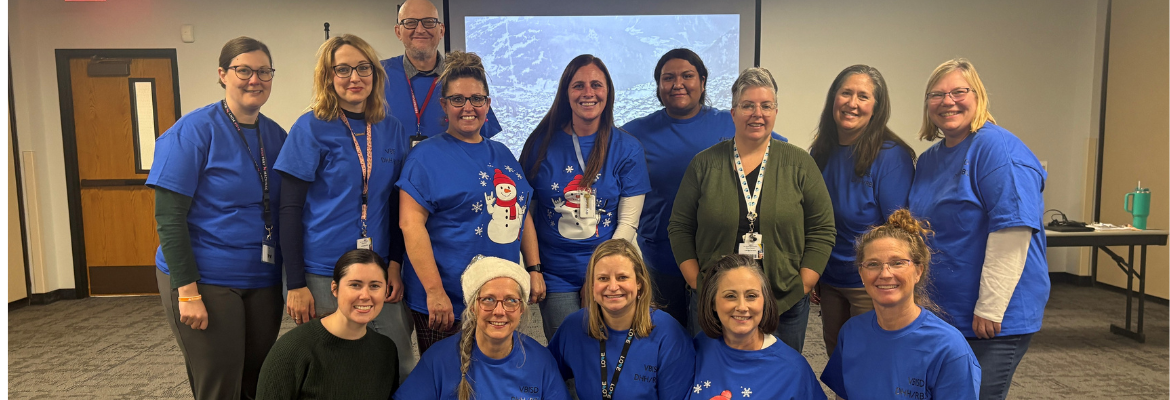
Students in rural communities who are blind/low vision (BLV) or deaf/hard of hearing (DHH) are often the only students in their school (or even district) with their disability. This can cause feelings of isolation. At Van Buren County Intermediate School District, the teacher consultants for BLV, orientation and mobility (O&M) specialists, and teacher consultants for DHH decided to address this issue by holding group lessons for their students.
At least once a quarter, students who are BLV and students who are DHH gather for activities that focus on the expanded core curriculum (ECC). These activities include cooking, service projects, museum visits, and sailing on the Friends Good Will ship. The district also held a family picnic, where parents, students, staff, and administration participated in activities, discussed students’ unique needs, and celebrated their successes.
Group lessons were first introduced by the district’s O&M specialists in the early 2000s to support a larger group of students in grades 6–12 who were BLV. These lessons provided opportunities for students to build social skills and address other ECC needs. Later, as more students who are BLV and DHH moved into the county, staff saw an opportunity to bring both groups of students together for these lessons.
Each year, the team plans a variety of outing types, including smaller groups based on age as well as larger outings for all students and their parents. Some lessons have smaller groups of 6-10 students, while one family outing had 44. At the end of the school year, the team meets to plan the next year’s group lessons, including activity ideas and a budget. After their plans are approved, they notify families.
“The original intent was to provide a mutual opportunity for shared learning experiences, for students to engage with the community and navigate opportunities and for the community to learn how to better accommodate those with disabilities,” says Jennifer Padgett, a DHH teacher consultant. “Getting these students together, who are often isolated in their individual schools, has provided much-needed camaraderie. Students are not only introduced to enriched academic content but also find ways to connect to one another and support each other.”
Mary Stap, a teacher consultant for BLV and certified O&M specialist, agrees.
“Fostering shared learning experiences and seeing the students in Van Buren County bond over hanging out with other kids who use similar compensatory skills and tools is so great,” she says. “For example, one student refused to use a white cane but is now embracing the idea. That is largely due to the influence of her group lesson friends. Many of these kids see each other socially outside of the group lessons now. They also encourage each other to attend other opportunities in our state, such as Camp Tuhsmeheta. There is such power in being with friends who really get it.”
One student, Maddi, says she enjoys spending time with her peers in a variety of fun settings.
“The group lessons are so much fun,” she says. “We’ve practiced O&M skills at the beach, at parks, in a busy neighborhood, and in a few restaurants. They allow us to get to know other kids with visual impairments or who are deaf and hard of hearing, which I don’t have in my school. Now we get together on some weekends and in the summer because we are such good friends.”
From Sara Cruchelow, MDE RBLV Education Consultant